It’s the question that comes up in almost every bathroom remodel where a tub currently exists and a larger shower is wanted: can you take the bath out, or does the house need one?
There’s no universal answer, but there is a useful way to think about it — and it has less to do with resale folklore than most people assume.
Start with how many bathrooms you have
This is the question that actually matters, and it changes the answer completely.
If it’s your only bathroom
Think carefully. Removing the only tub in the house is the version of this decision with real consequences. It affects bathing small children, it affects anyone who genuinely uses a bath, and it’s the scenario most likely to narrow the pool of future buyers.
That doesn’t make it wrong. Plenty of households never fill a tub, and a single well-built walk-in shower can be far more useful than a cramped tub-shower combination that does neither job well. But in a one-bathroom home it’s worth being deliberate rather than casual about it.
If you have more than one
The calculation gets much easier. Keep a tub somewhere in the house and you’ve preserved the option, which means the bathroom you’re remodelling can be optimised for how it’s actually used.
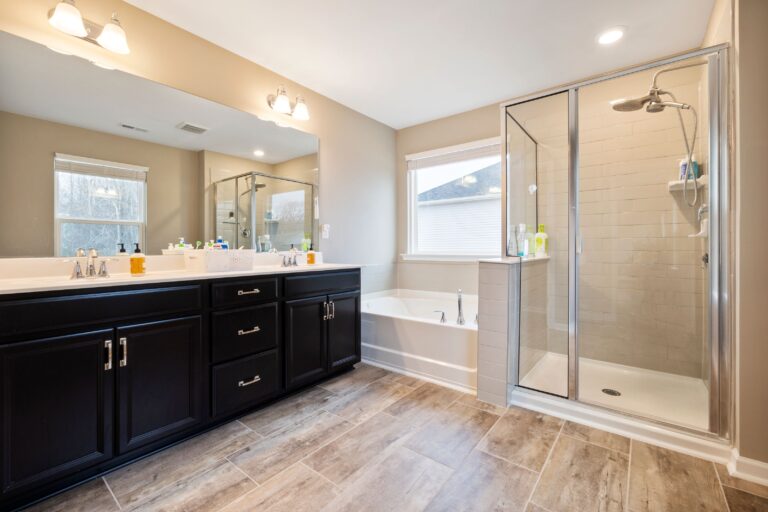
This is why converting a primary bathroom to a large shower while keeping the tub in the hall bathroom is such a common and sensible arrangement. Each room does one thing properly.
Be honest about actual use
The most useful question isn’t whether a house should have a tub. It’s whether anyone in yours has used one in the last year.
An enormous number of tubs exist purely as shower floors with high sides. If that describes yours, it isn’t providing a bathing function — it’s providing an awkward step and a curtain. Replacing it with a proper shower is a straightforward improvement to daily life.
Conversely, if someone in the household genuinely baths, or you’re bathing young children, or a long soak is something you’d miss, then it’s providing real value and the shower can be designed around keeping it.
Who the tub is for
A few situations where keeping one is worth weighting more heavily:
- Young children. Bathing small children in a shower is possible but harder, and this phase lasts years rather than months.
- Someone who genuinely uses baths. Not aspirationally — actually.
- Pets, or practical washing. Sometimes the most-used function of a tub has nothing to do with people.
- You expect to sell soon into a family market. Buyers with small children do look for a tub, and if a sale is near-term this carries more weight than it would otherwise.
Where a shower is the better answer
- The tub isn’t used for bathing. The single most common case.
- Stepping over the side is difficult, or may become so. A low-threshold or curbless shower is significantly easier to use, and it’s far cheaper to build that in during a remodel than to retrofit later.
- The room is small. Removing a tub and its curtain, and replacing them with a clear-glass shower, usually makes a compact bathroom feel considerably larger.
- The existing tub-shower combination does neither job well. A standard alcove is a mediocre bath and a cramped shower. Committing to one usually produces something better than both.
The resale question, honestly
You’ll hear confident claims in both directions. What can be said without overstating it: a house with no bathtub anywhere is a narrower proposition for buyers with young children, and that’s a real consideration. A house with several bathrooms where one has been converted to a well-built walk-in shower is not an unusual arrangement and is often seen as an upgrade.
What matters more than the fixture type is the quality of what replaces it. A beautifully built, properly waterproofed tiled shower reads as an investment. A cheap prefabricated unit dropped into the space where a tub used to be does not, regardless of which fixture buyers say they prefer.
If a sale is genuinely imminent, it’s worth asking a local agent about your specific market rather than relying on general advice. If you’re staying for years, build the bathroom you’ll actually use.
The middle options
It’s not always a binary choice:
- Keep the tub, improve the shower over it. A better valve, a proper glass panel instead of a curtain, and full-height tile transforms a tub-shower without removing anything.
- A smaller tub plus a separate shower, where the room can genuinely take both without cramping either.
- Convert this bathroom, keep a tub elsewhere. The most common good answer in a multi-bathroom house.
- Design the shower so a tub could return later. Keeping the drain and supply arrangement flexible costs little at rough-in stage and preserves the option.
What the conversion actually involves
Worth knowing before you decide: swapping a tub for a shower in the same alcove is not a like-for-like exchange. The drain usually has to move, the floor needs proper slope and a complete waterproofing system, wall tile typically goes higher, and glass replaces the curtain. It’s a genuine construction project rather than a fixture swap, which is why it’s worth doing once and doing properly.
How to decide
Count your bathrooms. Be honest about how the tub is used. Think about the next five to ten years in the house rather than the next five months. Then build the version you’ll use, and build it well.
If you’re leaning towards a shower, what a walk-in shower actually is explains the curbed and curbless options, what drives the price of a walk-in shower covers the cost, and cost to replace a shower sets out the three scopes this work can fall into. You can see finished work in our project gallery or get in touch.