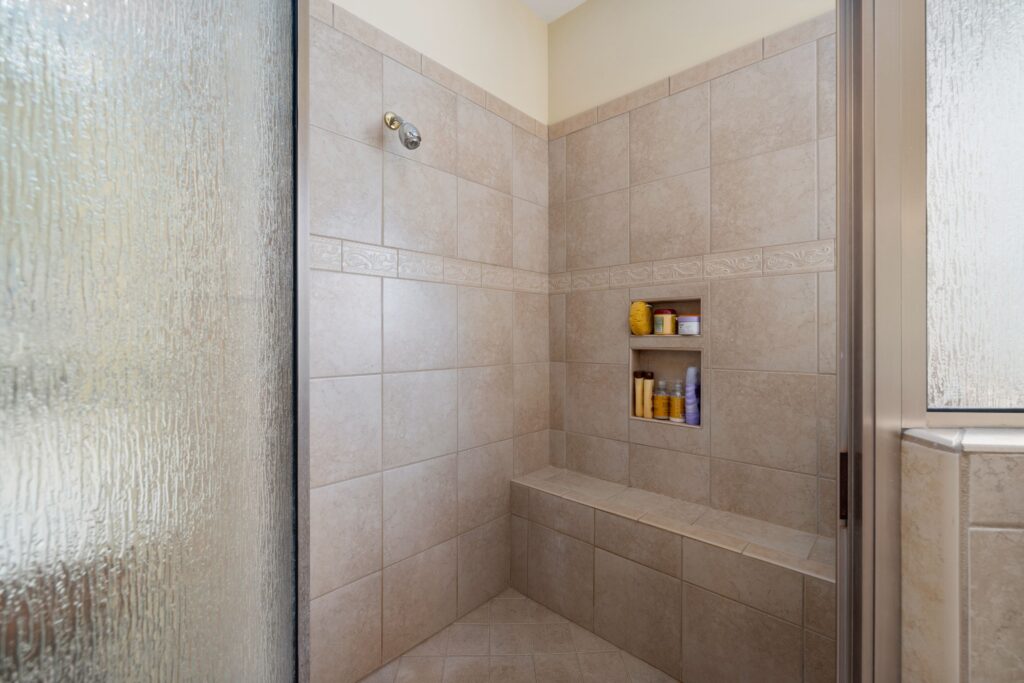
Walk-in showers are the most requested change in bathroom remodeling right now, and they’re also the item homeowners get the widest range of quotes on. It’s common to be told one number by a company selling a shower system and a very different number by a contractor who builds them from scratch — and both can be quoting honestly.
The reason is that “walk-in shower” describes how a shower is used, not how it’s built. Two showers that look similar from the doorway can be completely different assemblies behind the tile, with different amounts of labor, different lifespans, and different prices.
Here’s what’s actually in the number.
What you’re really paying for
In a tiled walk-in shower, most of the cost is in work you will never see once it’s finished. The tile is the last layer. Underneath it sits a sloped, waterproofed assembly whose entire job is to keep water out of the structure of your house for the next twenty years.
That assembly — the pan, the substrate, the waterproofing, and the way they’re joined at every corner and penetration — is the difference between a shower that lasts and one that quietly fails behind the wall. It’s also the part that’s easiest to cut cost out of, which is exactly why quotes vary so much.
The shower base
There are two broad approaches. A prefabricated base is a manufactured pan set in place, with tiled walls above it. A fully custom pan is built on site, sloped to the drain, and tiled to match the walls.
The prefabricated route is faster and generally less expensive. The custom route allows any size, any shape, a linear drain, a curbless entry, and a continuous tiled look. It’s more labor and more skill, and it’s the option that makes the shower feel built into the room rather than dropped into it.
Waterproofing
Methods vary, and they are not equivalent in cost or in approach. What matters is that a defined, complete system is specified — not simply “we’ll waterproof it.” Ask which method is being used and how corners, the curb, the niche and the drain connection are treated, because those transitions are where failures start.
Tile decisions that change the price
Format and size
Large-format tile means fewer grout joints and a cleaner look, but it demands a very flat substrate. Getting walls and floors flat enough is real preparation work, and skipping it produces lippage — tile edges that sit proud of each other — which is obvious under shower lighting.
Small formats and mosaics run the other way: less substrate preparation, far more pieces, far more labor. Mosaic shower floors are popular because the many small joints help with slope and grip, but they take time to set well.
Material
Porcelain is the workhorse for good reason: dense, consistent, low maintenance, available in an enormous range of looks. Natural stone — marble in particular — is beautiful and considerably more demanding. It’s heavier, more variable piece to piece, more easily damaged during installation, and generally needs sealing and gentler cleaning for the life of the shower. That extra care is legitimate labor and should be reflected in a quote.
Pattern and layout
A straightforward stacked or offset layout is efficient. Herringbone, chevron, vertical stacks and mixed-format designs generate more cuts, more waste and more setting time. The pattern is a design decision with a real labor cost attached, which is worth knowing before you choose one.
Glass
Glass is frequently the single largest line item after the tile itself, and it spans a wide range. A single fixed panel is the simplest option. Framed doors sit in the middle. Custom frameless enclosures — heavier glass, minimal hardware, made to measure — are the most expensive, and they’re typically measured only after the tile is complete, so they also affect the schedule at the end of the job.
Some walk-in showers are designed with no door at all, using the geometry of the room and a longer entry to contain spray. Done well that’s elegant and saves the glass cost entirely; done carelessly it puts water on your bathroom floor.
Curbed or curbless
A curbless shower — where the bathroom floor runs straight into the shower with no lip to step over — looks superb and makes the room feel larger. It’s also more work. The floor has to be lowered or built up to create the necessary slope, which usually means structural attention to the framing or subfloor, careful drain placement, and precise waterproofing across a much larger area.
It’s a genuinely worthwhile upgrade for plenty of homeowners. It is not a like-for-like swap, and any quote that treats it as one is worth a second look.
Niches, benches and built-ins
Recessed niches, corner shelves and bench seats each add framing, waterproofing and tile detailing. A niche is not just a hole in the wall — it’s five surfaces, several inside and outside corners, and edge treatment on every side, all of which has to be waterproofed as carefully as the rest of the enclosure.
They’re worth having. They just aren’t free, and a niche that’s been properly detailed and aligned with the surrounding tile layout looks noticeably different from one that was added as an afterthought.
Plumbing
Swapping a valve in the same location is modest work. Adding a second shower head, body sprays, a hand shower or thermostatic controls means more valve bodies, more supply runs and open walls. Moving the drain — which converting a tub alcove into a larger walk-in often requires — means working on the drain line and its venting, not just the finished surface.
Where to spend and where to save
If the budget needs managing, the sensible order is fairly consistent:
- Don’t economize on the pan, the waterproofing, or the substrate preparation. These are the parts you cannot correct later without demolishing the finished shower.
- Reasonable places to adjust: tile selection, pattern complexity, glass configuration, and fixture finishes. A simple layout in a good porcelain looks excellent and installs efficiently.
- Decide early on curbless versus curbed, and on the drain location. These are structural decisions, not finish decisions, and changing your mind after demolition is expensive.
Comparing walk-in shower quotes
To compare two numbers meaningfully, you need to know for each one: whether the base is prefabricated or custom-built, what waterproofing system is specified, how much tile is included and in what format, what glass is included, whether the drain is moving, and what happens if the framing or subfloor turns out to need work once the old shower is out.
A quote that answers those questions is a quote you can actually evaluate. One that just says “new walk-in shower” and gives a total tells you nothing about what you’re buying.
Because we handle our tile work in house, the shower is the part of a bathroom we can be most precise about at estimate stage. If you’d like to see finished examples, our project gallery shows completed showers and tile work, and our guide to what a bathroom remodel costs covers how the shower fits into a whole-room budget. You can also read more about our bathroom remodeling services or get in touch.